The Value Equation
Next week! Supporting subscribers, join me Feb. 24 for an exclusive Q&A with Neil Golden.
As the Chief Marketing Officer of McDonald’s USA for seven years, Golden helped establish and maintain the dollar menu, launch McCafé and reenergize the Happy Meal, Big Mac and Quarter Pounder, all while overseeing a $1.2 billion budget.
When he left, he expected he’d keep being an executive, but instead he found a new opportunity by looking closely at what work he wanted to do, and how. Bring your questions about developing and using broad principles to guide your professional decisions.
I always thought I was bad at math.
If you’d asked me as a kid what I wanted to be when I grew up, you would have gotten one of three answers: a reporter, a movie animator, or an astronaut. Somewhere around the time we started algebra, I kissed my space dreams goodbye when I decided that because math didn’t come easily to me, I should stay earthbound.
Imagine my surprise early in my career when I started not only applying math to my reporting and editing work, but enjoying it. I became a spreadsheet maven, and even ran a conference session called “Unleash spreadsheet magic,” complete with a prop magic wand. It wasn’t until statistics in grad school that I finally realized: I wasn’t bad at math in general. It was just harder for me to do abstract math; give me something concrete and I would plug away until I figured it out.
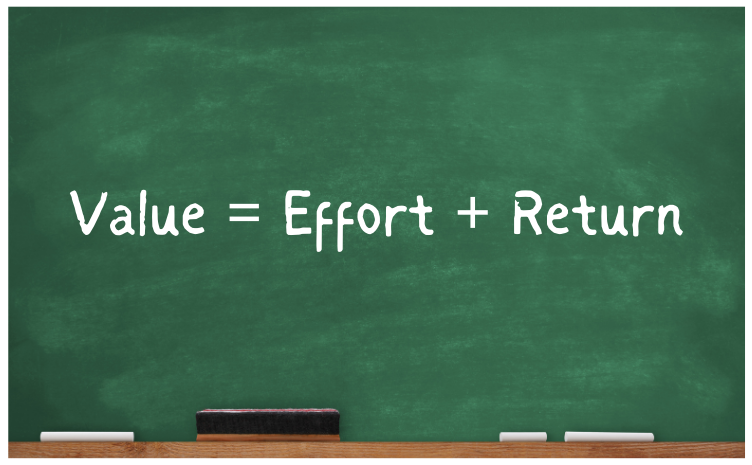
We put effort into what we care about. For me, it was digging out data that would inform our reporting. And for our careers, we can use a simple equation to see whether our work is offering us enough value.
Want full access to the Career River framework? Become a Navigator and receive this and other resources:
This is a question I turn to often when people are struggling to figure out whether it’s time to seek a new job: Are you getting as much (or more) out of your job as you’re putting into it?
In other words, when you combine the effort you’re putting into your work with the return you receive from it, what value do you feel you receive? If those two elements combined don’t give you a positive result, it may be time to look at tweaking the equation.
Effort: Are you going with the current?
For a moment, put yourself in a canoe. Feel the wood of the paddle gripped tightly in your hands, the warmth of the sun on your back, and hear the gentle splash of the water. Now dig in and push your paddle back through the water to propel yourself forward.
If you’re paddling with the current, you should be able to shoot forward easily. When I needed to wrangle some numbers for a reporting project, I’d quickly get immersed in the work. But if you’re going against the flow, every paddle stroke will take enormous effort to make even slight headway. That was my challenge with abstract equations — I didn’t see the point, and so it was harder for me to push through.
Have there been times in your work when you’ve been willing to put in more effort because you were intrinsically rewarded by what you were doing? That’s when you went with the current, following your natural inclinations. And were there times when you pushed hard to do what was expected of you, when you felt exhausted even though you hadn’t made much progress? It could be because you were battling against the current.
When you think about the effort part of your equation, consider both how hard you’re working and whether that’s going with or against your interests and abilities.
Return: What’s your work giving back?
Certainly, the return part of the equation can include your salary. But there’s more to it than only money. Remember that career progress can include growing your skills, stability or satisfaction with your work as well as moving up the corporate hierarchy.
So, what do you get out of your work? Perhaps it’s the satisfaction of making a difference, or learning something new. Maybe you enjoy the people you work with or like the challenges or flexibility it provides. Kristen Hare suggests looking at how three elements combine in her Work-Life Chemistry course, two representing choices you’ve made and one aspirational element (for example, Hare’s formula for a time was “flexibility, creativity and momentum”).
Be expansive when you consider what your work is giving you, and then it’s time to combine that with how much you’re giving to it. Do they balance? Have you found a role that’s giving you back even more than you’re putting into it? Or, if the scales are tipped in the opposite direction, is it a sign that it’s time to make a change — either with the effort you put in, the return you can get, or by finding something new altogether?
Putting it all together
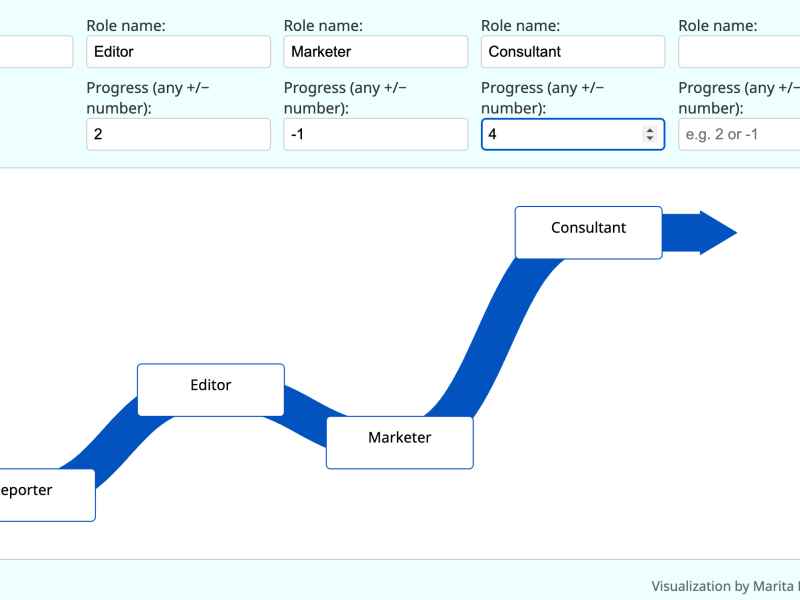
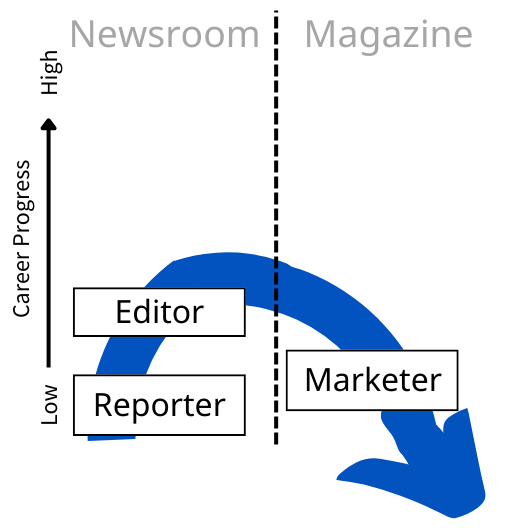
The story of Marita Pérez Díaz’s transition to tech shows how to put the Value Equation to use. First, see how she describes her burnout at her journalism job:
“I found myself doing at least 5 different roles in our small team. Despite being grateful for the opportunities to do journalism for the Cuban-American community and for being trusted to experiment with different tools, I was burned out and my mental health and emotional wellbeing were as poor as my income.”
In other words, high effort + low return = negative value. And then, when she switched to marketing:
“However, the change in values in my environment (plastic surgery industry) crushed my soul even more, despite the better pay. I was crying every day while driving to a toxic, sexist and superficial work environment with zero intellectual stimulation.”
In other words, the higher pay didn’t make her return part of the equation higher, because she was no longer getting the satisfaction of doing work she cared about. And it still took a good amount of effort. She wasn’t getting the value she craved.
And lastly, here’s her advice on how to find your way, as she did, to satisfying work that allows you to move with the current:
“Listen to advice but also keep true to yourself and to your core values. That is what is going to pay off at the end.”
Once you’ve looked at your Value Equation, you should have some clarity about what needs to change to make your work worthwhile.
Happy navigating,
Bridget
Author